
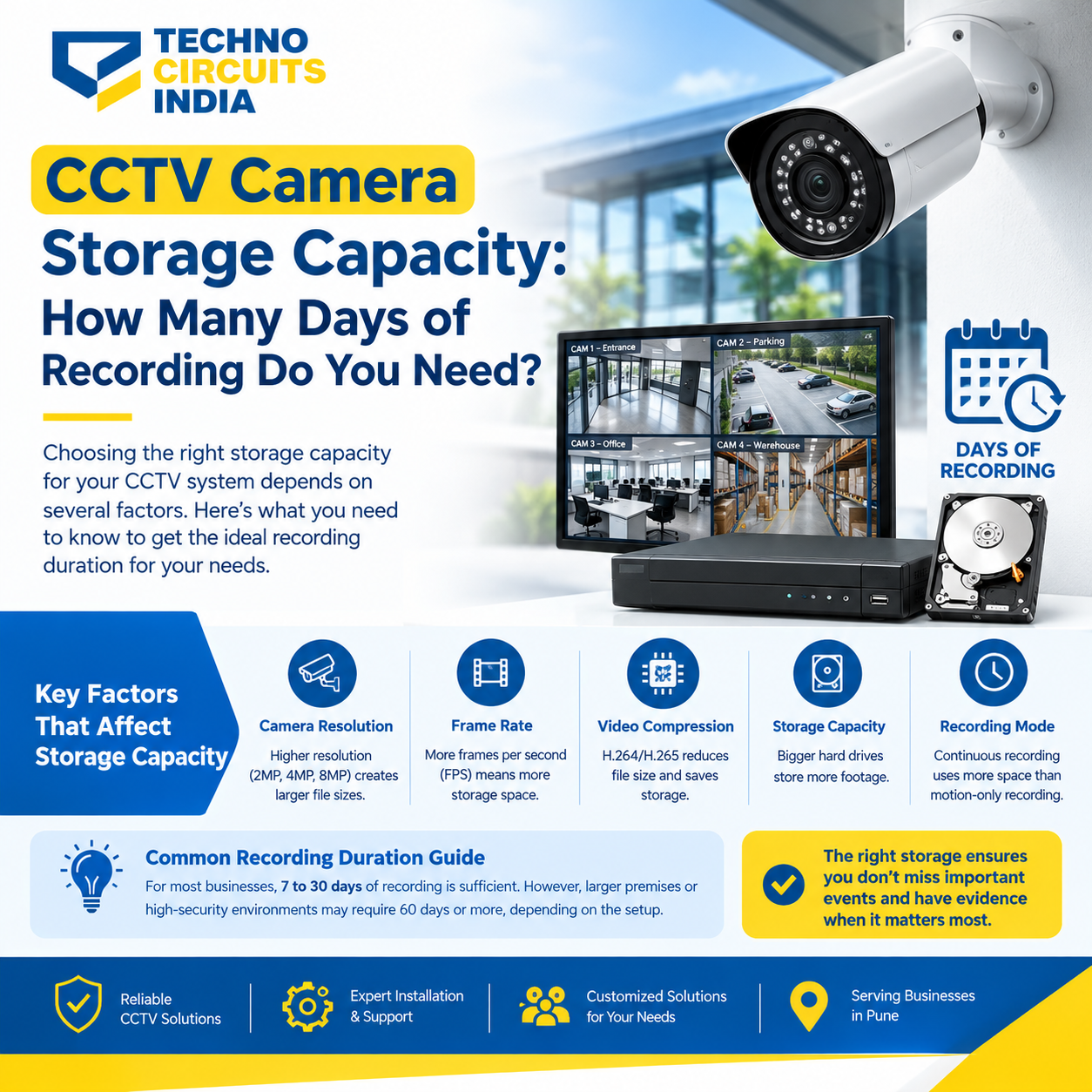
Choosing the right storage capacity is an important part of any CCTV installation. If your hard disk is too small, old recordings may be overwritten sooner than expected. If it is unnecessarily large, you may spend more than required.
For homes, offices, shops, factories and housing societies in Pune, the ideal CCTV camera storage capacity depends on the number of cameras, video resolution, recording settings and the number of days you want to retain footage.
What Determines CCTV Recording Storage?
1. Number of cameras
A system with 4 cameras generally requires less storage than one with 16 or 32 cameras, assuming similar settings.
2. Video resolution
Higher-resolution cameras capture more detail but can also generate larger video files, depending on compression and recording settings.
3. Continuous or motion-based recording
Continuous recording captures video throughout the day. Motion-based recording saves footage when activity is detected, potentially reducing storage needs.
4. Video compression
Technologies such as H.265 can reduce storage requirements compared with less efficient compression settings, depending on the camera and scene.
5. Required retention period
A home may need a different retention period from a factory, retail store or housing society. Decide how many days of footage you need before selecting the hard disk.
How Much CCTV Storage Do You Need?
There is no single hard disk size that suits every CCTV system. For an accurate estimate, consider the camera count, bitrate, recording schedule and required retention period.
A CCTV professional can calculate the approximate storage requirement and recommend a compatible surveillance-grade hard disk for your DVR or NVR.
Tips for Choosing the Right CCTV Storage
- Confirm that the DVR or NVR supports the intended hard disk capacity.
- Check the camera's resolution, bitrate and compression settings.
- Decide whether continuous or motion-based recording is appropriate.
- Allow for changes in the number of cameras and future expansion.
- Test playback and confirm that recordings are being saved correctly.
Conclusion
The right CCTV storage capacity helps businesses and property owners retain useful footage without unnecessary expenditure. Choosing a suitable hard disk requires more than counting cameras; recording settings and retention requirements matter just as much. Regular CCTV AMC services can also help keep recordings working reliably.
Need help planning a CCTV system in Pune? Techno Circuits India Pvt. Ltd. can help assess your camera setup and storage requirements. Call +91 70837 08306, explore our services, or contact us online.
FAQs
It depends on the hard disk capacity, number of cameras, recording settings and video compression.
Generally, yes, although the actual requirement also depends on bitrate and compression.
Yes. Motion-based recording can reduce storage use when there are periods with little or no activity.
Choose a surveillance-rated hard disk that is compatible with your DVR or NVR and supports your required capacity.